



California’s Healthcare Minimum Wage in 2026: What It Means for Job Seekers
Table of Contents

If you’re weighing a move into healthcare right now, there’s a policy shift worth knowing about. California’s new healthcare minimum wage took effect on July 1, 2026, raising pay floors for a much wider range of roles than most people realize. This post breaks down what changed, who it actually covers, and how CALRegional’s fast-track training programs can get you into one of these roles in a matter of weeks, not years.
Key Takeaways
- California’s healthcare worker minimum wage increased again on July 1, 2026, with rates now ranging from $19.28 to $25 per hour depending on the type of facility.
- The law covers a much broader set of roles than “nurse” or “doctor,” including patient care technicians, medical coding and billing staff, schedulers, and clerical workers.
- Not every employer is covered. The wage floor applies specifically to defined “covered healthcare facilities,” not every healthcare-adjacent job in the state.
- CALRegional administers short-term certification programs, including Medical Assistant, Medical Billing & Coding, and Phlebotomy Technician, that can prepare you for entry-level roles tied to this wage structure in as little as a few weeks.
Want To Learn More?
Where to Train for a Healthcare Career
CALRegional administers training programs through partner adult schools and the CALRegional Training Institute across California, with options to fit different schedules and goals. Three programs line up closely with the roles named in California’s healthcare worker minimum wage law.
Clinical Medical Assistant (CMA) training runs 8-10 weeks in a hybrid format that combines online instruction with hands-on labs, including a 160-hour externship, and leads to Clinical Medical Assistant Certification (CMAC). Medical assistant training California students complete this program well under the timeline of a traditional degree.
Read More: 6 Places Medical Assistants Can Work
Medical Billing & Coding Specialist (BCS) is a 100% online program that takes about 11 weeks to complete. It leads to Certified Billing & Coding Specialist (CBCS) certification, and no prior healthcare experience is required, though it’s helpful. A medical billing and coding career is one of the clearest direct matches to roles named in the new wage law.
Read More: What Is the Salary for Medical Billing and Coding in 2025?
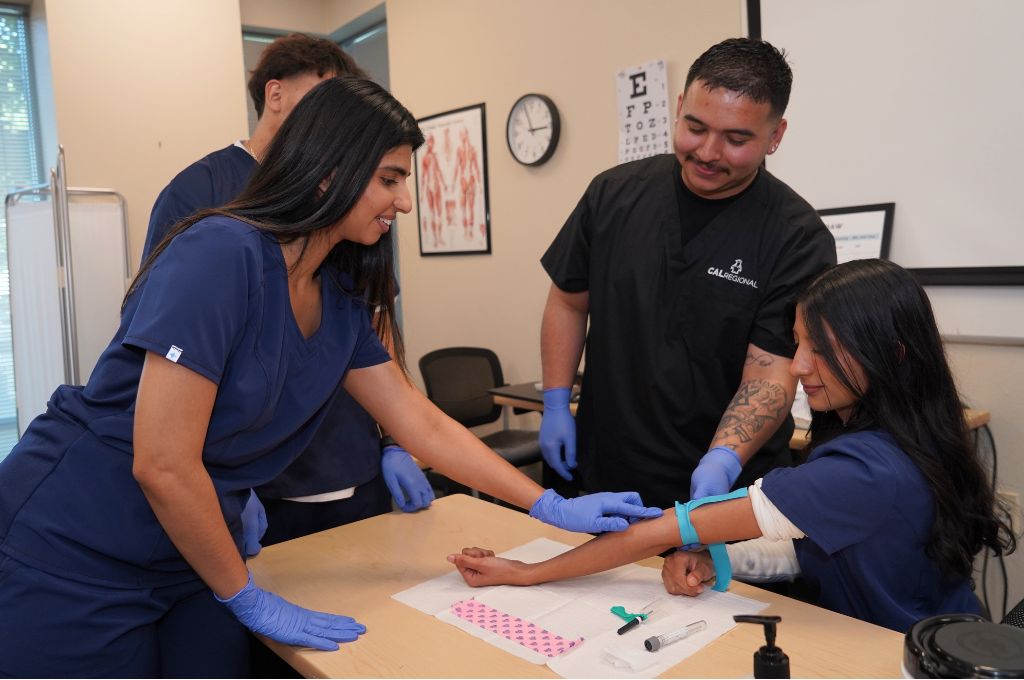
Phlebotomy Technician (PTC) training takes 3-12 weeks and includes hands-on lab work, with a guaranteed externship built into the program. Phlebotomy technician training through CALRegional has helped build a reputation as a leading program provider in the state.
Read More: Do Phlebotomists Make Good Money? Pay & Growth Reality
Each of these fast-track healthcare certification options is designed for career changers, including people with no healthcare background at all. All three programs are also administered through CALRegional’s partner schools in Texas.
What California’s Healthcare Minimum Wage Actually Covers
The California healthcare worker minimum wage isn’t a single flat number. It’s a tiered structure, and the rate depends entirely on the type of facility, not the job title.
| Facility Type | Previous Rate | New Rate (July 1, 2026) |
|---|---|---|
Large hospitals/health systems (10,000+ employees), dialysis clinics, large-county facilities | $24/hr | $25/hr |
Hospitals with 90%+ Medicare/Medi-Cal patients, rural independent facilities, small-county facilities | $18.63/hr | $19.28/hr |
Intermittent, community, rural, and urgent care clinics | $21/hr | $22/hr |
Medium-county and other covered facilities | $21/hr | $23/hr |
As of July 1, 2026, here’s how the tiers break down:This is where things get genuinely useful for job seekers. The law’s definition of “healthcare employee” is broad enough to include far more than clinical staff. It applies to patient care technicians, medical coding and billing personnel, schedulers, clerical workers, housekeeping staff, and several other support roles, as long as they work at a covered facility.
That last part matters. Not every medical office or private practice meets the definition of a “covered healthcare facility.” A physician’s group, for example, is only covered if it has 25 or more physicians, and many smaller private practices fall outside the law entirely. So while this law touches a wide range of job titles, it’s worth understanding which employers are actually bound by it before assuming every healthcare job in California pays at these rates.
Still, the practical takeaway holds. CA healthcare pay increase trends like this one reflect a broader direction in the state’s healthcare labor market, and training for a role the law specifically names, like medical billing and coding or patient-facing clinical support, puts you in a stronger position either way.
Why Healthcare Job Demand Is Climbing
This wage shift isn’t happening in isolation. Healthcare job demand in California is being shaped by a larger national trend toward vocational and short-term certification training.
Data shows vocational-focused public two-year colleges reached 871,000 students in spring 2025, nearly a 20% increase since spring 2020, with high-vocational enrollment surging 11.7% in that spring alone. Healthcare programs specifically, including medical coding and other entry-level clinical paths, are seeing double-digit enrollment gains, with starting salaries commonly in the $40,000 to $50,000 range. Much of this growth is being driven by Gen Z, who show nearly double the interest in vocational training compared to 2017.
The wage structure outlined by California’s Department of Industrial Relations backs this up from the employer side. A broadening wage floor paired with rising interest in short-term certification programs suggests no-experience healthcare careers are becoming a more practical entry point into the workforce, not a fallback option.
For career changers who’ve been on the fence, this combination of policy and demand is worth paying attention to. CALRegional-administered programs are built specifically around that kind of transition, with no prior experience required for most tracks.
FAQs
It depends on the facility type. As of July 1, 2026, rates range from $19.28 per hour at smaller or rural facilities up to $25 per hour at large hospital systems and dialysis clinics.
The definition is broad. It includes clinical roles like clinical medical assistants, as well as support roles such as medical coding and billing personnel, schedulers, and clerical staff, provided they work at a covered facility.
Covered facilities include hospitals, dialysis clinics, certain community, rural, and urgent care clinics, and physician groups with 25 or more doctors. Not every healthcare employer in California falls under this wage structure, including many smaller private practices, so it’s worth confirming with a specific employer.
Start Training for a Career That Fits This Moment
If you’re searching for healthcare career training programs near me, CALRegional administers Medical Assistant, Medical Billing & Coding, and Phlebotomy Technician programs across California and Texas, built for people starting with no healthcare background. Programs run as short as a few weeks, and easy interest-free payment plans are available. Everyone qualifies.
Ready to enroll in a healthcare training program California students have used to launch new careers in weeks, not years? Enroll online and find the program that fits your schedule.
Conclusion: A Wage Floor That’s Worth Paying Attention To
California’s evolving healthcare worker minimum wage shows no signs of slowing down, and it touches far more job titles than most people assume. Whether you’re drawn to medical billing and coding, direct patient care, or phlebotomy, CALRegional has a path that can get you trained and certified in a matter of weeks. With over 40,000 students trained since 2013, CALRegional continues building pathways into healthcare careers that are both fast and accessible.
Ready to Enroll?
